

Configuration Reference
Fire Trailer Pump Hose Nozzle Setup: A Configuration Guide
A planning reference for fire departments, rural property owners, ranches, utilities, and emergency response teams configuring the pump, hose reel, nozzle, suction hose, and discharge setup on a fire water trailer.
Components of a Fire Water Trailer Pump and Hose Setup
A fire water trailer is only as useful as the pump, hose, and nozzle that deliver its water. A practical fire trailer pump hose nozzle setup should be planned around the intended use case, available water sources, hose reach, refill plan, tow vehicle, and fire-readiness role. The tank holds water; the pump, hose reel, nozzle, suction hose, and discharge configuration are what move and apply it in the field.
Brush fire readiness on a rural property looks different from controlled burn standby on a working ranch, and both look different from staged emergency response support behind a utility crew. The same tank capacity can serve all three, but the pump, hose, nozzle, and discharge configuration that fits each job is not the same.
This page walks through how each component contributes, how flow rate works as a system result rather than a pump-only number, and how to translate the use case into a buildable specification. It is a configuration reference, not a product datasheet. For pump models, flow ratings, and pressure data, a Sales Specialist can match components to the task.
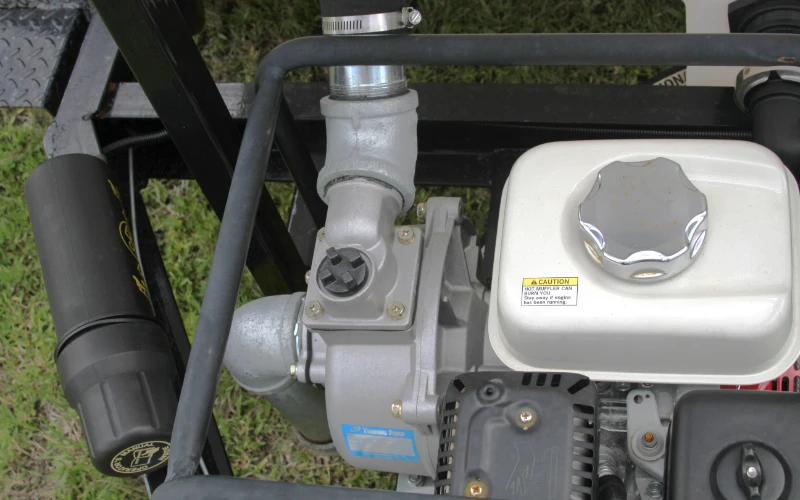 Water Movement
Pump
Moves water from the tank, and in some configurations from an external source, to the discharge. Must be matched to the hose, the nozzle, and the source.
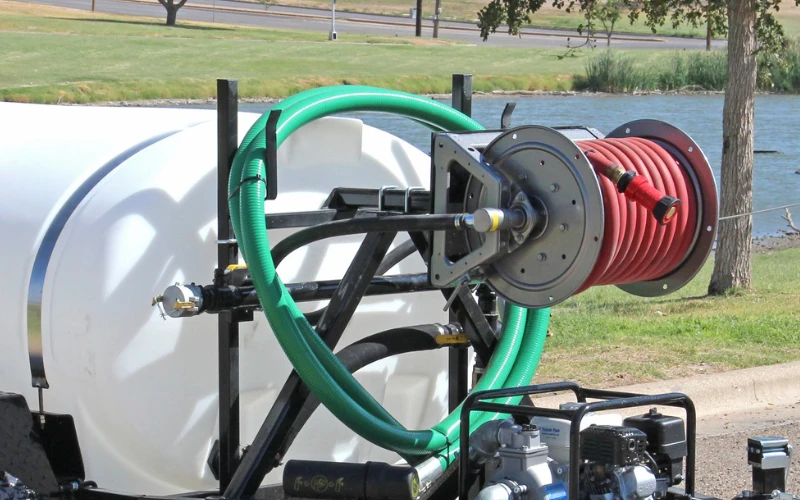 Deployment
Hose Reel
Stores the discharge hose and lets the operator deploy and redeploy it efficiently between staged positions. Optional on shorter setups, valuable on longer ones.
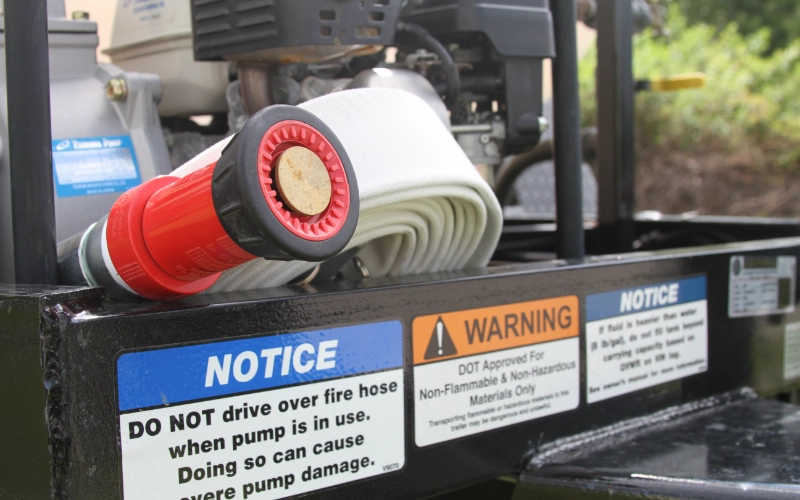 Application
Nozzle
Controls how water is applied: focused stream for reach, broad spray for cooling and wetting, or an adjustable pattern for flexibility on changing conditions.
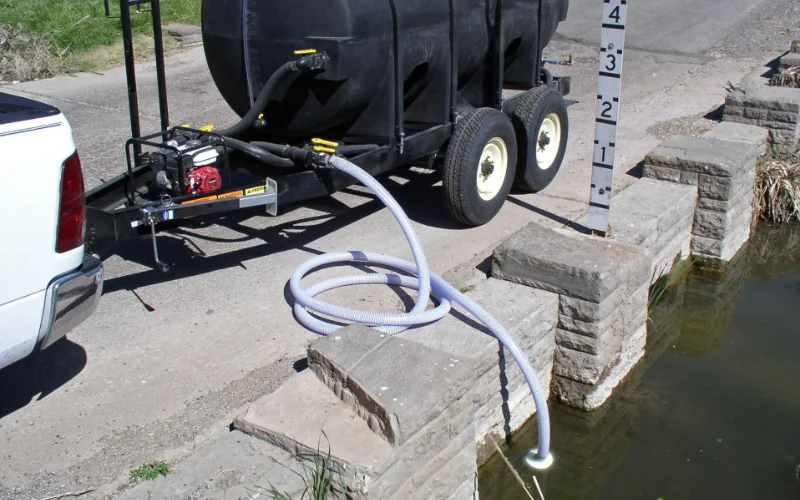 Inlet / Outlet
Suction Hose & Discharge
Determines where water enters and leaves the system, including drafting capability for refilling from an external source if the trailer is configured for it.
Why all four matter together
A capable pump matched to a too-small nozzle wastes capacity. A long hose without a reel slows redeployment. A high-flow nozzle on an undersized pump under-pressurizes at the operator's hand. A trailer with no suction setup has to leave the scene to refill. The components are a system, not a parts list, and configuration decisions should be made together rather than one at a time. For a broader product overview, see fire protection and emergency response water trailers.
How to Configure a Fire Fighting Water Trailer
Configuration starts with the use case. The same chassis and tank can support several fire-readiness roles, and each places different demands on the pump, hose, nozzle, and refill plan.
- Brush fire readiness
- Controlled burn standby
- Rural property fire support
- Structure defense
- Utility or municipal response
- Water transfer and refill
- Limited-access staging
Once the use case is named, three sets of questions decide the build.
Fire trailer nozzle and hose reel configuration
- How far must the hose reach from the trailer's staged position?
- Hose reel for fast deployment, or coiled hose acceptable?
- Stream, broad spray, or adjustable nozzle pattern?
- Will the trailer stay staged or move during use?
- Where does the operator stand?
- How is the hose drained, stored, and protected between uses?
- One operator or a crew?
Answers decide hose length, reel type, nozzle pattern, and where the discharge plumbing terminates. Confirm specific lengths, ratings, and spray distances against verified product data.
Fire trailer pump flow rate
Flow rate at the nozzle is a system result. It depends on pump capacity, hose diameter and length, nozzle, operating pressure, tank capacity, and water source. A high-flow pump paired with an undersized hose or a restrictive nozzle will not deliver its rated output.
- Higher flow drains the tank faster and can overshoot the task.
- The pump must be matched to the hose and nozzle, not specified in isolation.
- Tank capacity and refill logistics determine how long flow can be sustained.
- Confirm specific GPM and pressure targets with a Sales Specialist or local fire authority.
Fire trailer suction hose and discharge setup
Configuration depends on whether the trailer pulls only from its onboard tank or also drafts from an external source like a pond, cistern, or fill point.
Discharge side is the focus
Where the discharge port is, what hose connects to it, and how the operator routes that hose to the application point.
Suction setup matters too
Type of suction hose, source connection, pump priming behavior, and safe staging near the water source.
Plan discharge direction and operator position in advance so the trailer can be set up and worked without repositioning. Water trailer accessories cover the suction, discharge, and hose components that round out a configuration.
Configuration Considerations to Verify Before Purchase
The seven items below translate the use case into the questions a buyer should be able to answer (or have a Sales Specialist answer) before placing an order.
-
Define the primary use case before specifying components.
Brush fire readiness, controlled burn standby, rural property protection, utility response, or staging support each lead to different pump, hose, nozzle, and discharge decisions. Specifying components without naming the use case usually leads to mismatched setups.
-
Confirm where the trailer will be filled and whether it will draft.
A tank-only trailer needs a fill port and a discharge plan. A trailer that needs to pull from an external source needs suction hose, drafting-capable plumbing, and a primable pump. Confirm this before the build, not after.
-
Match hose length and reel type to operator workflow.
The hose has to reach the work area from where the trailer can stage safely. If the operator will redeploy frequently, a hose reel pays back fast. If the trailer stays in one position, a coiled hose may be enough.
-
Specify nozzle pattern based on how water needs to be applied.
Stream for reach, broad spray for cooling and wetting, adjustable for flexibility. The nozzle and pump have to be matched so the system performs as expected at the operator's hand.
-
Confirm tow vehicle capacity against loaded trailer weight.
Water weighs roughly 8.34 pounds per gallon, so even a modest tank adds substantial loaded weight. Verify GVWR, axle ratings, brake setup, and hitch class against the tow vehicle and the routes the trailer will travel.
-
Plan the operator workflow before specifying the build.
Will one person operate the trailer, or a crew? Where will the operator stand? How will the pump be started, the nozzle controlled, and the hose drained? A configuration that looks good on paper can be awkward to work in the field if the workflow is not planned.
-
Verify component-level details with a Sales Specialist before purchase.
Pump model, flow, pressure, hose ratings, and nozzle specifications should all be confirmed in writing before the order is placed. Configuration guides like this one frame the questions; the answers come from a quoted specification.
Fire Trailer Configuration Checklist
A scannable verification list. Print it, attach it to a purchase request, or use it as a planning aid before contacting a Sales Specialist.
Fire Trailer Pump, Hose, Nozzle & Discharge Configuration Checklist
- Primary use case named: brush fire readiness, controlled burn standby, rural property protection, utility response, or staging support.
- Fill plan confirmed: where the trailer will be filled and how often.
- External source drafting decision made: tank-only or drafting-capable, with suction hose specified if needed.
- Hose reach from the staged position to the expected work area confirmed.
- Hose reel decision made based on deployment and storage needs.
- Nozzle pattern specified: stream, spray, or adjustable.
- Realistic flow expectations reviewed against the system, not the pump alone.
- Operator count confirmed: solo or crew, with workflow planned around it.
- Public road travel assessed: registration, lighting, and brake requirements verified for the jurisdiction.
- Tow vehicle compatibility confirmed against loaded trailer weight.
- Open verification questions documented for review with a Sales Specialist before purchase.
Fire Control Options to Review
Each option below is configured for fire-readiness use. Specific pump, hose, reel, nozzle, and discharge details should be verified against current product data before purchase. Note: configuration callouts are placeholders pending fact-check.
![[Fire fighting trailer image alt]](image-files/364-0631-1025-fire-protection-non-dot-800x500.webp)
Fire Fighting Trailer
Standard fire response water trailer configurations for rural fire support, controlled burn standby, and property protection planning.
✓ Pump, hose, and nozzle configurations available
View Fire Fighting Options![[Fire Ranger water trailer image alt]](image-files/365-0548-fire-ranger-on-truck-man-spraying-800x500.jpg)
Fire Ranger Skid Sprayer
Compact fire response skid sprayer configured for brush fire readiness, limited-access staging, and quick-deploy property protection use.
✓ Compact configuration for limited-access staging
View Fire Ranger Options![[Water trailer accessories image alt]](image-files/honda-pump-with-accessories-400x400.webp)
Water Trailer Accessories
Hose reels, nozzles, suction hose, and discharge components for outfitting or upgrading a fire water trailer setup.
✓ Components for tailoring an existing setup
View Trailer & Skid AccessoriesFrequently Asked Questions
Start with the use case (brush fire readiness, controlled burn standby, rural property protection, utility response, or staging support), then match the pump, hose, nozzle, suction, and discharge components to that task. Tow vehicle capacity, refill access, and operator workflow should all be reviewed before purchase. A Sales Specialist can walk through the configuration based on specific project needs.
There is no single best pump setup. The right pump depends on the intended task, the hose and nozzle being used, the tank capacity, and whether the trailer needs to draw from an external source. Pump selection should be matched to the rest of the system, not chosen in isolation.
A hose reel is helpful when the operator needs to deploy hose quickly, redeploy between locations, or store hose neatly between uses. Some configurations work without a reel, particularly when hose lengths are short or the trailer stays in one position during use.
Flow rate at the nozzle depends on the pump capacity, hose diameter and length, nozzle, operating pressure, tank capacity, and water source. Flow rate is a system result, not a pump-only specification. Realistic flow expectations should be reviewed with a Sales Specialist or local fire authority where applicable.
Nozzle selection depends on how water needs to be applied: a focused stream for reach, a broad spray for cooling or wetting, or an adjustable pattern for flexibility. The nozzle must also be matched to the pump and hose so the system performs as expected.
A suction hose lets the trailer draw water from an external source such as a pond, tank, or fill point, depending on the configuration. Not every fire trailer setup includes drafting capability. If external refill is needed, suction and priming details should be confirmed before purchase.
Many fire trailer setups can be operated by one person if the hose reel, nozzle, pump controls, and tow vehicle staging are planned around solo operation. Larger configurations or active fire response often benefit from a second operator. Plan operator workflow before specifying the setup.
Related Guides
![[Fire Ranger water trailer thumbnail alt]](image-files/365-0548-fire-ranger-render-main-272x228-042026.webp)
About this reference: This page is a configuration guide for fire water trailer pump, hose reel, nozzle, suction hose, and discharge setup. It is not a fire suppression specification, an NFPA-compliant build sheet, or a substitute for guidance from a local fire authority. Pump, flow, pressure, hose, and nozzle specifications should be confirmed in writing with a Sales Specialist before purchase.
Download the configuration checklist
The same checklist on this page, formatted as a printable PDF for purchase planning and supplier conversations. Email required.
Get the PDFTalk to a Sales Specialist
Need help configuring a fire water trailer? A Sales Specialist can review pump, hose reel, nozzle, suction hose, and discharge options against your fire-readiness plan.
Request a Quote