

Decision Guide
Do You Need DOT for a Farm Water Trailer?
If your trailer will travel on public roads, plan for a road-legal configuration. If it stays on private farm roads and pastures, a simpler off-road setup may be all you need.
Do You Need DOT for a Farm Water Trailer? Start With Where It Travels
Not every farm water trailer is used the same way. Some trailers never leave the property. They fill troughs, water arenas, and move between barns and pastures on private farm roads. Others have to travel on public roads between properties, leased fields, barns, or a public fill point. Whether you need DOT configuration for a farm water trailer depends on where it will travel, how it will be towed, the loaded weight of the trailer, local requirements, and whether the trailer must be road legal for public-road use.
Getting this wrong is expensive in both directions. Buy an off-road setup and later discover the trailer has to cross a county road to reach your second pasture, and you have a trailer you cannot legally move where you need it. Buy a fully road-configured trailer for a job that never leaves the ranch, and you may pay for equipment and upkeep the work does not require. The goal of this guide is to help you sort out which direction fits your operation before you talk to a Sales Specialist. It is not legal advice, and DOT and CDL details should always be verified for your location and use case.
Road Legal vs Off Road Water Trailer: Side by Side
Read down the left column and stop at the factors that match your operation. The right setup follows from how and where the trailer is used, not from the trailer alone.
| Decision factor | Non-DOT / Off-Road Setup | DOT-Ready / Road-Legal Setup |
|---|---|---|
| Where it travels | Private property only: farm roads, ranch lanes, fields, paddocks, and pastures. | Public roads between properties, fields, barns, or refill points, plus everything an off-road trailer does. |
| Road-use equipment | Typically a simpler configuration because the trailer is not intended for public-road travel. | May need lighting, brakes, reflectors, registration, and appropriate tires depending on use and jurisdiction. |
| Compliance to verify | Confirm the trailer truly stays on private property year round, including refills. | Confirm applicable DOT, state, and local rules before operating on public roads. |
| Loaded weight and towing | Loaded weight and tow vehicle fit still matter for safe handling on farm terrain. | Loaded weight can affect braking, registration, and licensing considerations, so it carries extra weight in this decision. |
| Operator staffing | Often planned as a one-operator setup for daily trough filling and pasture watering. | Can also be run by one operator, with added attention to hitching, lighting checks, and road-safe loading. |
| Typical farm scenarios | Trough filling, arena watering, livestock water access, and watering near the barn or paddocks. | Hauling water from a public fill point, serving multiple properties or leased land, and fleet or municipal-style operations. |
| Best for | Farms and ranches where the trailer never leaves private property and a simple one-person setup is the priority. | Operations that move water on public roads, work across multiple properties, or run trailers as part of a commercial or municipal fleet. |
When a Non-DOT Farm Water Trailer May Fit
A non DOT farm water trailer is built around one assumption: the trailer stays on private property. If that assumption holds for your operation, the simpler setup is often the practical choice. Keep in mind that this is conditional, and rules vary by state and local area, so confirm what applies to your property and use.
-
The trailer never leaves the property
Water moves between a well or storage tank and troughs, paddocks, barns, or arenas, all on your own farm roads. Public-road travel simply is not part of the routine.
-
The work is pasture and livestock focused
Trough filling, arena watering, and livestock water access near the property are the core jobs. An off road water trailer for ranches handles this kind of work on ranch lanes and pasture terrain.
-
You want the simplest farm-use setup
One owner or one ranch hand tows, fills, and discharges without managing road-use equipment the operation does not need.
Recommended for Off-Road Farm and Ranch Use
These agricultural water trailers are a natural starting point for private-property watering work.
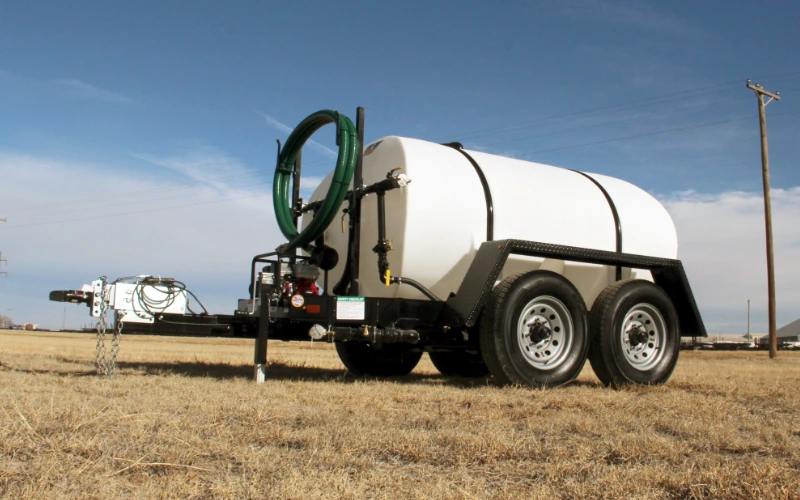
800 Farm Water Wagon
Haul and spray water around the farm for trough filling, crop irrigation, livestock care, and dust control.
✓ Customizable spray bar, tank, and decking options
View Details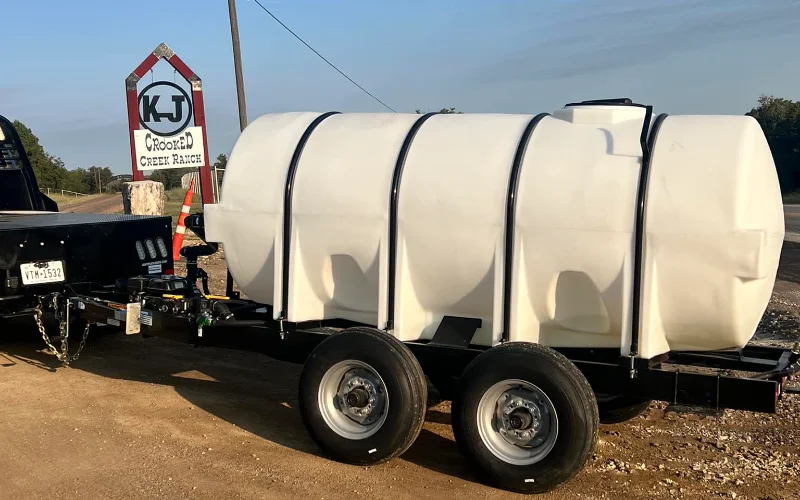
1025 Gallon Arena Water Trailer
Over 1,000 gallons for arena watering, pen and stall work, and water hauling, with a convenient top fill port and bottom dispensing port.
✓ Available in DOT and non-DOT builds
View Details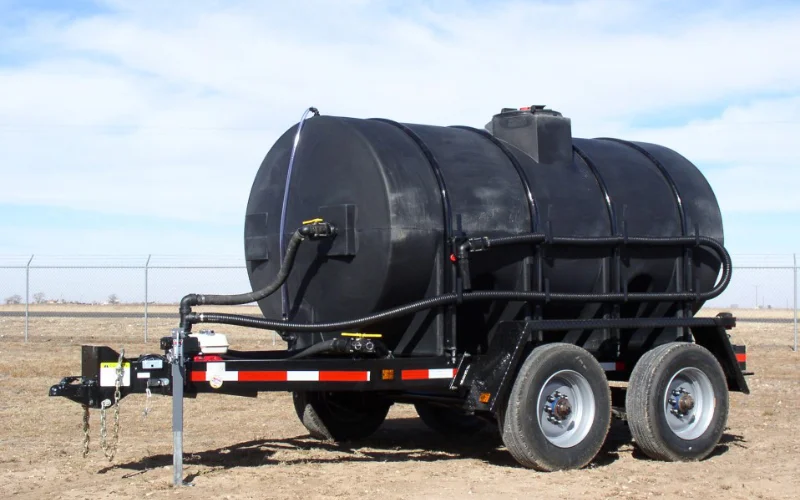
1600 Gallon Nurse Water Trailer
A high-capacity tandem-axle nurse trailer built specifically for on-farm hauling of water, fertilizer, and ag liquids.
✓ Electric brakes standard, gooseneck or tag hitch
View DetailsWhen DOT Configuration May Be Needed
If the trailer will spend any regular time on public roads, plan the purchase around road use from the start. Adding road-legal capability after the fact is harder than buying for it up front.
-
The trailer travels between properties or leased land
Moving water across town or down a county road puts the trailer in public-road use, where lighting, braking, registration, and other road-use requirements may apply depending on loaded weight and jurisdiction.
-
Crews haul water from a public fill point
If the refill routine itself involves public roads, the trailer needs to be configured for that trip every time, not just for occasional moves.
-
The trailer is part of a municipal, commercial, or fleet operation
Fleet work usually means multiple operators, scheduled routes, and oversight, so a trailer that can be safely and legally transported outside private property becomes a requirement rather than a convenience.
Recommended for Road-Use Configurations
These trailers can be discussed in a road-ready direction with a Sales Specialist based on your routes and loaded weight.
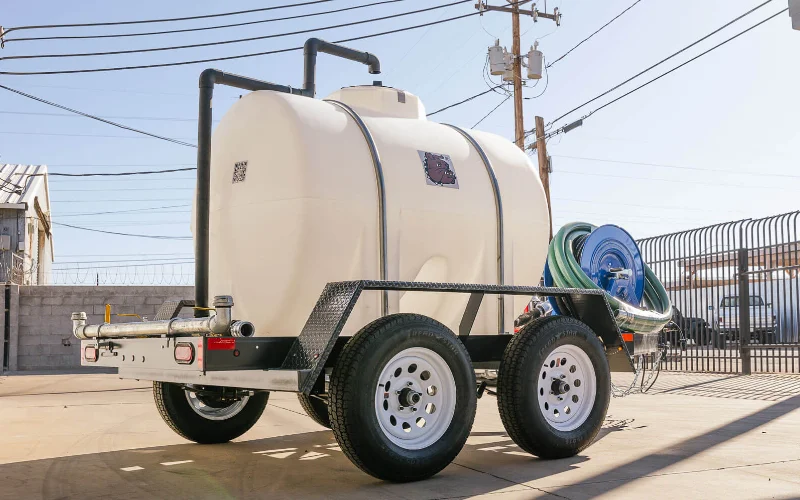
325 Gallon Water Bowser Trailer
A compact single-axle bowser sized for one person to tow, fill, and move water between properties.
✓ Potable and non-potable configurations
View Details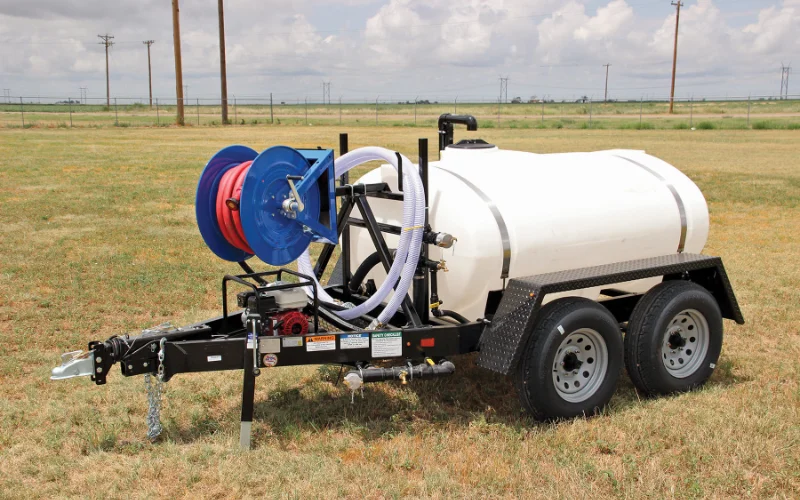
550 Gallon Express Water Trailer
A road-ready mid-size trailer for hauling from public fill points, with pump, hoses, and spray equipment included.
✓ DOT-compliant with LED brake lights
View Details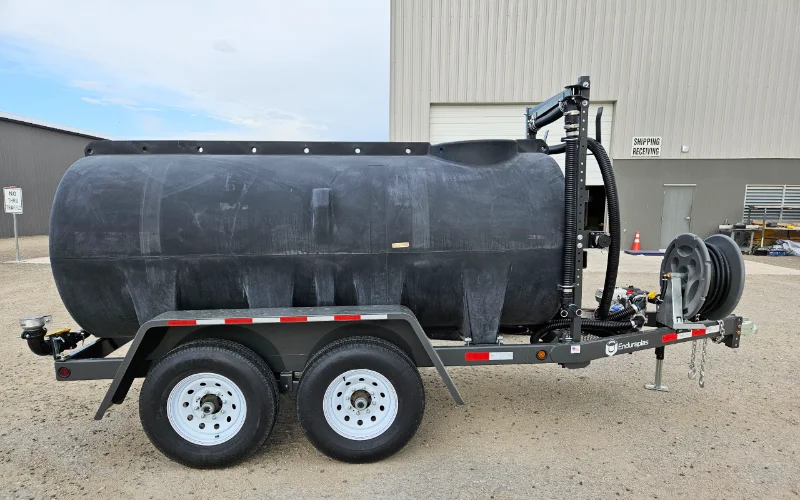
1010 Gallon DOT Water Spray Trailer
High-capacity DOT-compliant hauling and spraying for operations that move water on public roads between properties.
✓ Tandem axles with dual rear spray nozzles and 100 ft hose reel
View DetailsFarm Water Trailer No CDL Required: What That Really Depends On
Many buyers search for a farm water trailer no CDL required, and the instinct behind that search is sound: most farms want a trailer the existing truck and the existing operator can handle. But whether a CDL applies is not a property of the trailer alone. It can depend on trailer weight, combined vehicle weight, the use case, your jurisdiction, and whether the operation is personal, agricultural, commercial, or public-road related.
Treat this as a verification point, not a promise. A practical way to plan is to know your tow vehicle's ratings, estimate the trailer's loaded weight including water, and then confirm the licensing rules that apply to that combination in your state. Water is heavy, and a trailer that seems modest empty can be a very different tow when full. A Sales Specialist can help you compare water trailer sizes against your tow vehicle so the conversation with your local authorities starts from accurate numbers.
Planning a One Person Operated Farm Water Trailer
On most farms, ranches, and equestrian properties, watering is one person's job. A one person operated farm water trailer setup means that single operator can tow, fill, position, and discharge without help. Whether you land on a DOT-ready or off-road configuration, walk through these practical points:
- Tow vehicle compatibility. The trailer's loaded weight should sit comfortably within what your truck or tractor is rated to tow.
- Hitch setup. A hitch arrangement the operator can connect and disconnect alone, without a spotter.
- Maneuverability. Tight barn aisles, gates, and paddock corners decide how easily one person can position the trailer where the water needs to go.
- Pump vs gravity-feed setup. The discharge method changes the workflow for filling troughs and watering arenas, so match it to the daily routine.
- Hose storage. Hoses that stow on the trailer keep the routine to one trip and one set of hands.
- Fill and discharge access. Fill ports and valves the operator can reach and work without climbing or a second person.
- Staged or mobile. Decide whether the trailer moves between paddocks daily or stays staged near the work, since that changes how much towing convenience matters.
If pasture access and gate widths are tight on your property, raise them early in the configuration conversation. They often shape the right answer more than capacity does. You can also review farm water wagon options for a sense of how simple farm watering setups are arranged.
Common Mistakes Buyers Make
These come up again and again on quote calls, and every one of them is avoidable with a few minutes of planning.
-
Assuming the trailer will never touch a public road
The trailer stays on the farm until the day it needs to refill in town or water a leased pasture down the road. Map out every place the trailer might realistically travel over the next few years before deciding it is off-road only.
-
Sizing the trailer without checking loaded weight
Buyers compare capacities but forget that the water itself is most of the towed weight. Estimate the full loaded weight against your tow vehicle before settling on a size, whichever configuration you choose.
-
Treating CDL and registration questions as someone else's problem
Licensing and registration rules vary by state, weight, and use. Verify what applies to your combination before the trailer arrives, not after, so the first haul is not the first surprise.
-
Ignoring the one-operator workflow
A trailer that needs two people to hitch, fill, or discharge quietly doubles your labor for every watering run. Walk through the daily routine step by step and make sure one person can do all of it.
Related Guides
Frequently Asked Questions
It depends on where the trailer travels. A trailer that stays on private farm roads, pastures, and ranch lanes may not need road-use configuration, while a trailer that travels on public roads may need lighting, brakes, reflectors, registration, and other road-legal equipment depending on loaded weight and jurisdiction. Confirm the DOT, state, and local rules that apply to your location and use before operating on public roads.
CDL requirements depend on trailer weight, combined vehicle weight, the type of operation, and your jurisdiction. Many buyers plan a setup that stays within their tow vehicle and operator limits, but you should verify the rules for your specific configuration and location rather than assume no CDL is required.
A road-legal water trailer is configured for public road travel, which may include lighting, brakes, reflectors, registration, and appropriate tires depending on use and jurisdiction. An off-road water trailer is intended for private property only, such as farm roads, ranch lanes, fields, and pastures, and is typically a simpler setup.
A non-DOT trailer is intended for private property use. Whether any trailer can legally travel on public roads depends on its equipment, loaded weight, registration status, and the rules in your state and local area. If your trailer will leave private property, plan for a road-use configuration and confirm the applicable requirements first.
Many farm and ranch setups are planned so one person can tow, fill, position, and operate the trailer. The keys are tow vehicle compatibility, a manageable hitch setup, trailer maneuverability through gates and paddocks, accessible fill and discharge points, hose storage, and a pump or gravity-feed arrangement matched to the job.
Start with where the trailer will travel. If it stays on private farm roads and pastures, an off-road setup may fit. If it travels on public roads between properties, fields, or fill points, plan for road-use configuration. Then factor in loaded weight, tow vehicle, who operates it, and any state or local requirements. A Sales Specialist can walk through the options for your operation.
Ready to Move?
If you already know whether your trailer needs road-legal configuration, send us your details and we'll respond with a quote the same day.
Request a QuoteStill Deciding?
Need help choosing the right farm water trailer configuration? Talk to a Sales Specialist about DOT-ready, non-DOT, off-road, and one-person operated water trailer options for farm, ranch, and equestrian use.
Talk to a Specialist